
Contents
Picture this: a storm rolls through overnight, and by morning your power is out. The fridge is warming up, your phone is at 12%, and you have no plan. That scenario plays out for millions of households every year, and the difference between inconvenience and genuine hardship almost always comes down to preparation made weeks earlier.
The good news is you don’t need to spend thousands upfront. Home emergency power backup strategies work best when treated as a progressive investment, not a single purchase decision.
Start With a Load Assessment, Not a Product Search
Before comparing any hardware, identify what you actually need to keep running. As Palmetto Energy’s team puts it, “by focusing on essential or emergency loads, you can get the most cost effective solution.” That prioritization is the foundational decision everything else builds on.
Most households fall into one of two categories:
- Basic comfort needs: lighting, phone charging, a fan, and refrigerator access
- Critical medical needs: CPAP machines, oxygen concentrators, electric wheelchairs, or home dialysis equipment
If someone in your home depends on electrically powered medical equipment, your backup requirements jump significantly. A CPAP machine typically draws 30–60 watts; an oxygen concentrator can pull 300–600 watts continuously. Those numbers must anchor your system selection before anything else.
A simple watt-hour calculation helps: multiply each appliance’s wattage by the hours per day you need it, then add everything together. That total sets the minimum capacity your backup system must deliver.
The Four-Tier Backup Framework
Structuring your approach around outage duration keeps decisions manageable and spending proportional.
Tier 1 (0–8 hours): A portable power station in the 500–1,000 Wh range handles lighting, device charging, and a small fan. Models from brands like Jackery or EcoFlow require zero installation. According to Art of Manliness’s tier-by-tier backup power guide, portable power stations are the easiest entry point for most homeowners.
Tier 2 (8–48 hours): An inverter generator or a mid-capacity portable power station paired with solar panels bridges short to medium outages. Inverter generators run quieter than conventional models and produce cleaner power that’s safe for sensitive electronics. The r/preppers community broadly recommends this category as the practical middle-ground option.
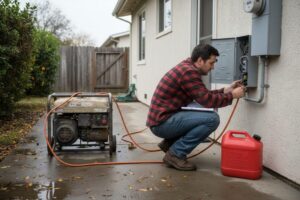
Tier 3 (3–7 days): A large portable generator (5,000–10,000 watts) or a home battery system like the Tesla Powerwall covers extended outages. For generators, a manual transfer switch or interlock kit is legally required in most jurisdictions to prevent backfeed onto utility lines. NEMA recommends keeping enough fuel on hand for at least 48 hours of operation as a baseline.
Tier 4 (Extended or indefinite): Solar-plus-battery systems with automatic transfer capability represent the most resilient long-term strategy. NOAA’s Weather Ready Nation program confirms that “several manufacturers are now offering scalable battery solutions that connect directly to the home and can power an entire household, including HVAC systems.” The federal Inflation Reduction Act tax credit (30%) significantly reduces upfront costs for qualifying battery installations.
Safety Is Non-Negotiable
Carbon monoxide poisoning kills dozens of Americans annually during power outages, almost always from generators operated indoors or too close to the home. Current CDC and CPSC guidelines require placing generators at least 20 feet from windows, doors, and vents, with exhaust directed away from the structure.
For fuel storage, gasoline treated with a stabilizer stays viable for 12–24 months. Propane stores indefinitely under proper conditions, which is one reason dual-fuel generators have grown popular for longer-term preparedness planning.
Modern Battery and Solar Integration
Home battery systems handle outages differently than generators. During a grid outage, properly configured solar-plus-storage systems use automatic transfer switches to island from the grid and continue charging from solar panels. Without this setup, solar panels shut down automatically through a safety feature called anti-islanding, which prevents backfeed onto utility lines.
Bidirectional EV charging (V2H) is an emerging option worth monitoring. The Ford F-150 Lightning, Hyundai Ioniq 5, and select Nissan Leaf models can export power back to the home, effectively turning your vehicle into a mobile battery. The home battery backup options covered by NYT Wirecutter include helpful context on how these systems compare to dedicated storage units.
For homeowners evaluating full battery systems, our complete home battery backup system review breaks down real-world runtime data, installation costs, and which systems qualify for the IRA tax credit.
Putting It All Together
Start with your load list. Match your tier to realistic outage durations in your region, and prioritize safety equipment like CO detectors and proper transfer switches before adding capacity. The technology has never been more accessible, and waiting until the grid fails to start planning is the one mistake every preparedness expert agrees on.