
Contents
Sunlight hits your roof every single day, and somewhere in that light is enough energy to power your entire home. According to the U.S. Department of Energy, the solar radiation striking Earth’s surface in just 1.5 hours is enough to power the entire world for a full year. The challenge has always been capturing it efficiently, and that’s exactly what modern solar panels are designed to do.
The Photovoltaic Effect: Where It All Starts
Every solar panel runs on the same fundamental physics principle: the photovoltaic effect. When photons from sunlight strike a solar cell, they knock electrons loose from their atoms. Those free electrons start moving, and moving electrons are electricity.
Solar cells are made from semiconductor materials, typically silicon, arranged in layers with opposite electrical charges. This creates a built-in electric field that forces freed electrons to flow in one direction, generating direct current (DC) electricity. Think of it like water pressure in a pipe: the electric field is the pressure, and the electrons are the water.
As Palmetto’s solar team explains, solar panels convert solar energy from sunlight into electrical energy through the photovoltaic effect. Simple in concept, remarkable in execution.
The Three Types of Solar Panels
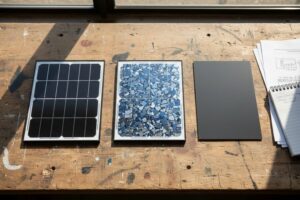
Not all panels are built the same. The semiconductor material used determines efficiency and ideal use case.
Monocrystalline Silicon: Cut from a single crystal structure, these panels offer the highest efficiency at 17 to 22 percent. They’re the premium choice for most residential installations where roof space is limited.
Polycrystalline Silicon: Made from multiple silicon fragments melted together, these panels run at 15 to 17 percent efficiency. They cost less per watt, making them a solid budget-friendly option.
Thin-Film: These use non-silicon materials like cadmium telluride, with efficiency topping out at 10 to 13 percent. They’re lightweight and flexible, ideal for commercial rooftops or unconventional surfaces.
From Sunlight to Wall Outlet
Understanding the full journey from panel to plug clarifies how all the components work together:
- Sunlight hits the solar panels, triggering the photovoltaic effect and generating DC electricity.
- DC electricity flows to the inverter, which converts it into alternating current (AC), the standard form used by home appliances.
- AC electricity powers your home directly, running lights, appliances, and devices in real time.
- Excess electricity feeds back to the grid through net metering, earning you credits on your utility bill.
- Battery storage (optional) captures surplus energy for use at night or during outages.
The inverter is the unsung hero of any solar setup. String inverters handle whole-system conversion, microinverters work panel by panel, and power optimizers sit somewhere in between. Microinverters are generally the better choice for roofs with shading issues, since one underperforming panel won’t drag down the rest of the system.
Environmental Impact: Beyond the “Clean Energy” Label
Solar’s environmental case goes deeper than the buzzword. A typical residential system offsets roughly 3 to 4 metric tons of CO2 per year, comparable to planting over 100 trees annually. The EIA notes that solar PV technology scales from powering a wristwatch all the way up to utility-scale power stations, making it one of the most versatile renewable technologies available.
Panels do require energy to manufacture, but their energy payback period is typically just 1 to 4 years depending on panel type. Given a lifespan of 25 to 30 years, that’s decades of net-positive clean energy production.
What This Means If You’re Considering Solar
Understanding the science is the first step. The practical step is figuring out whether solar makes sense for your specific home, roof angle, local utility rates, and budget. Federal tax incentives currently cover 30 percent of installation costs in the U.S., and upfront costs have dropped dramatically over the past decade.
If you’re ready to move from curious to committed, our complete home solar system guide walks through panel options, installation timelines, and real-world ROI estimates to help you make a confident decision.
Is Solar Energy Only for Sunny Climates?
No. Solar panels generate electricity from daylight, not direct sunlight. Germany, one of the cloudiest countries in Europe, consistently ranks among the world’s top solar energy producers. Efficiency drops on overcast days, but panels still produce meaningful output.
Do Solar Panels Work at Night?
Panels don’t generate electricity after dark since there’s no sunlight to trigger the photovoltaic effect. Battery storage systems or grid connection cover nighttime electricity needs. Net metering credits earned during the day effectively offset what you draw from the grid at night.
How Long Do Solar Panels Last?
Most quality panels carry a 25-year performance warranty and remain functional well beyond that. Degradation rates average around 0.5 percent per year, meaning a panel producing 400 watts today will still produce roughly 350 watts after 25 years.