
Contents
Starting a woodworking shop feels overwhelming fast. You’re staring down aisles of saws, sanders, and specialty gear with no clear sense of what actually matters on day one. The good news: you don’t need everything at once, and a smart, phased approach makes the whole process far less expensive and stressful.
The Basic vs. Beginner Tool Distinction
Before buying anything, understand a critical nuance. As the Popular Woodworking editorial team puts it, “basic woodworking tools are different from beginner woodworking tools.” Basic tools reflect a skill set; beginner tools reflect a starting point. Knowing which category you’re shopping for prevents you from buying gear you’re not ready to use, or skipping tools you genuinely need right now.
What Most Beginners Actually Need First
Two independent YouTube creators separately landed on 13 as the ideal starter tool count, which is a useful benchmark. But the real question isn’t how many tools to own; it’s which ones to buy first.
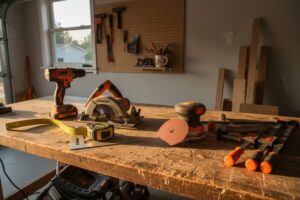
Here are the absolute fundamentals to start with:
- Tape measure and speed square for layout and marking
- Cordless drill/driver for assembly and fastening
- Circular saw for breaking down sheet goods and lumber
- Random orbital sander for surface prep and finishing
- At least four to six clamps for glue-ups and workholding
This core set handles the majority of beginner projects, from simple shelves to basic furniture boxes, without requiring a large upfront investment.
A Phased Buying Roadmap
Spreading purchases across three phases keeps costs manageable and ensures each tool gets real use before the next one arrives.
Phase 1, Day-One Essentials: Focus on the five tools listed above. A decent cordless drill, a circular saw, and a tape measure can all be sourced for well under $200 if you shop sales or buy refurbished.
Phase 2, Month 1 to 3 Additions: Add a miter saw for accurate crosscuts, a jigsaw for curved cuts, and a solid workbench or clamping surface. This phase unlocks furniture-grade projects and significantly improves cut accuracy, with a total spend under $500.
Phase 3, Skill-Building Setup: A router opens up joinery and edge profiling. Marc Spagnuolo of The Wood Whisperer advises: “A plunge router is by far the better choice. Fixed routers are difficult to use for making things like mortises. So if at all possible, go with a plunge base.” Add a table saw once your projects consistently require rip cuts.
Hand Tools vs. Power Tools
This debate comes up constantly in beginner communities, and the honest answer is: both matter. Hand tools like chisels, a block plane, and a pull saw build fundamental skill faster than power tools alone. They’re also quieter, cheaper, and work in small garages or apartments without dedicated circuits.
Power tools, on the other hand, dramatically increase speed and consistency for repeat cuts. The smartest approach combines them. Buy a cordless drill and circular saw early for efficiency, then add a chisel set and hand saw to develop technique. You can find a beginner woodworking tool checklist that covers both categories in detail if you want a complete reference.
Budget Realities and Cost-Saving Strategies
Most beginner guides mention budget constraints without actually addressing them. Here’s a realistic breakdown across three starting scenarios:
- $300 starter kit: Tape measure, speed square, cordless drill, circular saw, four clamps, and an orbital sander. Buy mid-range brands on sale.
- $750 serious beginner kit: Everything above, plus a miter saw, jigsaw, and basic chisel set.
- $1,500 well-equipped shop: Add a router, router table, and dust collection. The NWWA Forum community recommends at least 650 CFM capacity for a functional shop dust collector.
Buying used is one of the most underutilized strategies. Inspect used power tools for smooth switch action, no wobble in the chuck or blade arbor, and clean vents. Avoid used sanders and jigsaws with heavy wear on the base plate.
Shop Infrastructure Basics
Tools alone don’t make a functional workspace. You need a sturdy workbench or clamping table, adequate lighting, and basic dust management. Sawdust accumulates fast and becomes both a health hazard and a fire risk without a shop vac or dust collector running during cuts.
Safety gear is non-negotiable from day one:
- Safety glasses rated for power tool use
- Hearing protection appropriate for your loudest tools
- A dust mask rated at least N95 for fine particulate
For a deeper look at how specific tools perform across beginner projects, our complete beginner woodworking tools guide walks through top picks at every budget tier.
Corded vs. Cordless: A Quick Answer
For most beginners, cordless wins on flexibility and safety, especially in a garage shop without dedicated outlet placement. The exception is a table saw or miter saw, where corded motors deliver more consistent power under load. For drills, circular saws, and sanders, cordless is the practical default in 2025.
The Reddit woodworking community sums it up well: prioritize a good tape measure, a thousand pencils you’ll inevitably lose, and don’t overthink the rest. Start small, build projects, and let your actual work tell you what tool to buy next. That feedback loop beats any shopping list.